Thursday, June 10, 2010

BP Tries to Disperse Concern amid Calls for Prosecutions and Reform

Talk Nation Radio for June 10, 2010
BP Tries to Disperse Concern amid Calls for Prosecutions and Reform, Dr. Ira Leifer, Flow Rate Tech Group, Scott West, Retired EPA Special Agent

UPDATE: From the Deep Water Horizon Pooling Experts here. There was an error when we tried to log on to the Flow Rate Technical Group here:

Scott West, former Special Agent in Charge, EPA. See BP, Beyond Prosecution here.

Breaking News Update: The White House has announced that they have received a new flow rate assessment about the BP spill. The company is now promising an ability to contain as much as 60,000 to 80,000 barrels of oil per day from their leaking pipe in the Gulf of Mexico. Here is a paragraph from the statement that arrived via the White House list serve to Talk Nation Radio: "The Lower Marine Riser Package (LMRP) cap that is currently in place can capture up to 18,000 barrels of oil per day. At the direction of the federal government, BP is deploying today a second containment option, called the Q4000, which could expand total leak containment capacity to 20,000-28,000 barrels per day. Overall, the leak containment strategy that BP was required to develop projects containment capacity expanding to 40,000-53,000 barrels per day by the end of June and 60,000-80,000 barrels per day by mid-July".

Energy Secretary Steven Chu said: “This estimate brings together several scientific methodologies and the latest information from the sea floor, and represents a significant step forward in our effort to put a number on the oil that is escaping from BP’s well.”

They are now claiming that they have planned for contingencies to deal with a worst case scenario, which is exactly what our guest last week, Dr. Ira Leifer of the Government's Flow Rate Technical Group, indicated was the best approach. We transcribed our interviews for last week's show and you can read them below.

Dori Smith, talknationradio@gmail.com


Produced by Dori Smith
TRT: 29:00
Download at Pacifica's Audioport here and at Radio4all.net and Archive.org

Dr. Ira Leifer, an associate researcher at the Marine Science Institute of the University of California, Santa Barbara, Flow Rate Technical Group.

BP gives out low numbers on flow from broken pipe. We hear better analysis. If the DOJ and Bush administration had backed EPA official's call for criminal prosecution, safety might have improved. Plus Nalco as manufacturer of dispersant chemical. See: BP Tries to Disperse Concern amid Calls for Prosecutions and Reform.

BP Task Force Commander, Admiral Thad Allen, told press at a June 9, 2010 Q and A that the oil plume spewing from BP's broken pipe in the Gulf of Mexico, had a flow rate of 19,000 to 25,000 barrels per day. It's becoming a pattern though. Again the government appears to be helping BP to downplay the continued damage.

Dr. Ira Leifer is on the Government's Flow Rate Tech Group. He confirms what he told the press, (McClatchy) that when you use BP's own assessment of a worst case scenario, you get more like 100,000 barrels per day as a flow rate. Then, former EPA investigator Scott West joins us to go over BP's history of criminal negligence and catastrophe. He says the spill wouldn't have happened if the Bush administration and Justice Department had backed his effort to prosecute BP officials.

In May, NPR's Richard Harris asked Dr. Steven Wereley, of Purdue University, to study the videotape and use his technique for calculating low rate from speed of particle movement. BP had said 5,000 barrels of oil were flowing from the pipe per day. Wereley told NPR that the flow rate was more like 70,000 barrels per day. Other researchers confirmed the higher numbers.

At a press conference June 9th, the National Incident Commander on the spill, Admiral Thad Allen, said between 19 and 25,000 gallons were coming out of the pipe per day, that after the pipe was sheared to accommodate a containment cap. The company had trapped 15,000 barrels during the previous twenty four hour period and hoped to double that in the coming weeks. So the report seemed positive. But the NPR reporter tried to pin the admiral down on where the numbers came from. He said he would have to check, but thought they had come from the government's technical team working on flow rate.

When we spoke with one of the technical team members, Dr. Ira Leifer, he confirmed his assessment based on BP's own data, that the flow could be more like 100,000 barrels per day. The team has been reviewing satellite and underwater camera data. Admiral Allen did say that a higher resolution video tape is being provided to the researchers. Dr. Ira Leifer is a well known scholar at the Marine Science Institute of the University of California. We asked him to confirm his estimate that 100,000 gallon per day might be flowing out now, a figure he gave to McClatchy News Service that was picked up by Reuters and other media.

http://www.talknationradio.org


Transcript: Talk Nation Radio, June 9, 2010
Producer/host: Dori Smith

“…Once I found out it was BP’s rig, I felt that nothing had changed within the criminal corporate culture that we had found and indeed that this was no accident, it was the result of criminal decisions”.
Scott West

‘I’m quite confidence that in the long term, that basically the truth will out’. Dr. Ira Leifer

Dr. Ira Leifer joins us to talk about his assessment as part of the government's flow rate technical group analyzing the amount of oil spewing into the Gulf of Mexico from the BP/Transocean spill.

‘And BP, which is able to afford a great number of attorneys can just simply overwhelm the federal government with its legal representation’. Scott West, BP, Beyond Prosecution

Then, former EPA investigator Scott West joins us to go over BP's history of criminal negligence and catastrophe. We look at the problem of getting good information from BP or the government, as a pattern has been forming. BP tries to disperse public concern by offering low numbers and the Obama administration reinforces them.

In May, NPR's Richard Harris asked Dr. Steven Wereley, at Purdue University, to study the videotape of the oil flowing out of the pipe and use his technique for calculating low rate from speed of particle movement. ‘We’re talking more than a factor of 10 difference between what I calculate and the number that’s being thrown around’.

BP had said 5,000 barrels of oil were flowing from the pipe per day. Wereley told NPR that the flow rate was more like 70,000 barrels a day. Other researchers also got the much higher numbers.

At a press conference June 9th, the National Incident Commander on the spill, Admiral Thad Allen, said between 19 and 25,000 gallons were coming out of the pipe per day at this point:

Admiral Thad Allen: ‘We have a bunch of technical experts got together and they came up with two ranges; of 12,000 to 19,000 and 12,000 to 25,000. Until we get better data that becomes the rebuttable uh assumption on flow and everything else’.

That after the pipe was sheared to accommodate a containment cap. The company had trapped 15,000 barrels during the previous twenty-four hour period and hoped to double that in the coming weeks. But again, NPR wanted more clear information. Where the numbers came from, BP or the government? ‘My knowledge was it was the task group but I will check back and if I misunderstood it I will make a clarification on it. They are going to be looking at that again they have high-resolution video that was taken after the riser pipe was cut, that’s been brought back on hard disk and that’s exactly what the group is analyzing right now’.

When we spoke with one of those technical experts working for the government’s team, Dr. Ira Leifer, he confirmed his assessment based on BP's own data, that the flow could be more like their worst-case scenario of 100,000 barrels per day. We asked him to confirm the reports in McClatchy and then Reuters, citing the 100,000 figure:

Dr. Ira Leifer: Let me just say what I had intended to say which is that in the absence of good quality data which was our situation until very recently, the flow clearly had increased significantly. The question is how much. And there are two ways two ways to do go about that. One is you get data and you analyze it, that’s called science. The other way was to just take BP’s own estimate of a worst case scenario of freely flowing pipes and just put that out there: This is what BP thinks would happen when a pipe freely flows from that reservoir, now by pipe I mean the pipe that is the problem with this well, into the ocean. And BP’s number was 100,000 barrels per day. It does not mean that I think 100,000 barrels per day is flowing out, it could be less it could be more. The whole point of science and being a scientist and agencies working on this and the people is to actually come up with a number. And again, previously BP was very reticent about providing data, not letting us do our work. Now they have become much more helpful and forward looking at providing the data. I assumed they kind of realized that they don’t like their own number very much and they would actually finally like for us to be able to come up with a good number.

Dori Smith: Well Dr. Leifer we heard this morning from Admiral Thad Allen that BP captured 15,000 barrels overnight in 24 hours. That still leaves 85,000 according to your estimation.

Dr. Ira Leifer: I would just point out again its BP’s worst case scenario. The question is, is the flow from that well worst case? Is it even worse than that? Or is it not as bad. So what I would argue from looking at the videos is however much oil is coming out its large enough relative to 15,000 that it did not make an appreciable dent in it. That means it’s certainly more than double that and the amount is something that we should be able to figure out within a day with the results of the new data.

So the amount of oil that still remains to be captured could be conceivably within another mere expansion to 30,000 total but it also could be larger. And this is where we need to know by analyzing data and I think what has come out of including BP’s own worst case scenario is that they are much more cooperative and forward looking now and helpful so that we can actually do out job so that the efforts that go on are done safely.

Dori Smith: And of course NOAA is testing deeper samples of water to try to discover oil there, but why is it so difficult to assess this and does it have to do with the Corexit, the Nalco product that was used to disperse the oil. And if so would that affect the tests that are now being sent to laboratories like ALPHA here in New England.

Dr. Ira Leifer: the challenge is, it’s hard enough to figure out where the oil is going to go at the sea surface where you actually can look at it from an airplane or boat and track it. In the three dimensions of the ocean it is far more difficult challenge to find where hit has gone. Because the other thing is that the ocean is vast. If the oil is dispersed throughout the water column, that’s the idea behind dispersants, then the concentrates go down to very small amounts. That should not have anything to say with whether or not those very small amounts are problematic to the ecosystem. Very small amounts of petroleum hydrocarbon in the water column are known to cause all sorts of problems with fish and so on. But because the amounts are so small, they are hard to find. It’s not easy to find when something gets so diluted. And there was a lot of word done on this particular aspect after the Exxon Valdez because scientists were in fact able to take a look at the effects on fish and other life forms in the ocean from the petroleum hydrocarbon dose, even years later from he sediment into the water column.

Dori Smith: Well we were concerned when one of NOAA’s tests turned out to establish that there was a similarity between oil they found at more than 3,000 ft down and the oil spewing from the spill but then on later follow tests they couldn’t establish that. Then we read that there may be a conflict of interest with the labs or that even BP is doing some of these tests themselves.
Friday, May 21, 2010
FROM WIRE REPORTS Ian Urbina, The New York Times
In coastal communities along the Gulf of Mexico, environmental officials are feverishly collecting water, sediment and marine animal tissue samples that will be used in coming months to help track pollution levels resulting from the oil spill.
GERALD HERBERT/The Associated Press, Boat captain Preston Morris shows oil that got on his hands while collecting samples in marshes at Pass a Loutre, La.--Hundreds of millions of dollars are at stake, since those readings will be used by the federal government and courts to establish liability claims against BP.


Dr. Ira Leifer: In that regard I’m quite confident that in the long term, that basically the truth will out. It is not possible for anyone to have a complete control of all of these oil samples from the ocean and I think the laboratories know that if they did not do a very high quality analysis that other entities with own boats collecting water samples would very rapidly be releasing information that would be in contradiction to their laboratory. The one thing that these laboratories value above everything else is their reputation and I would imagine that in order to protect their reputation they would, realizing that other people would also be collecting and analyzing water samples, would be very honest in that regard. I certainly can’t promise that but I imagine that they would want to do that because this is such a large spill, there are so many people who are going to be trying to understand what happened, and so on, that you can’t hide things for very long when so many people are looking.

Dori Smith: Dr. Ira Leifer is a well-known scholar at the Marine Science Institute of the University of California. We turn now to Scott West, an EPA agent in the criminal division, he took calls from workers complaining that BP’s pipeline in Prudhoe Bay Alaska, was vulnerable.

Scott West: What I did with the EPA, I was a criminal investigator with the criminal investigation division and in Seattle I was special agent in charge up until I retired in October of 2008. The State of Alaska fell under my area of responsibility. And in 2005 I received information from some employees working on the North Slope up at Prudhoe Bay that a particular transit line was full of sludge and they had grave concerns about erosion causing the pipeline to rupture. They had brought these concerns to their officials, supervisors and other officials at BP and they were ignored and even chastised. So they came to me and there wasn’t much we could do until March of 2006 when that pipeline did indeed rupture and cause the second largest oil spill in Alaska.

We started a criminal investigation immediately and carried it forward for the next year and a half. It was a robust investigation enjoying a great deal of support by the EPA and the Department of Justice. Then unexpectedly in August of 2007 I was informed that the Justice Department had decided to grant BP’s wishes to settle this case along with the cases involving an explosion at a BP refinery in Texas City, and a propane trading violation in Chicago.

They wanted to wrap these all up together and so the Justice Department shut down my investigation, worked out the misdemeanor plea with the company for the Alaska case and that was that. And so when the rig exploded in the Gulf, and once I found out it was BP’s rig, I felt that nothing had changed within the criminal corporate culture that we had found and indeed that this was no accident, it was the result of criminal decisions.

Dori Smith: And of course, the U.S. Justice Department, once again investigating British Petroleum, we’re reading about a lot of money…

Scott West: …They’re not investigating British Petroleum.

Dori Smith: OK, correct me.

Scott West: Yeah, the Attorney General Last Tuesday came out publicly and under I believe pressure that’s been coming on from the public about why isn’t there a criminal investigation? And he made the statement that indeed there is an investigation and he cited the statutes that one would expect: The Clean Water Act, the Rivers and Harbors of the Refuse Act, and the Migratory Bird Treaty Act. Now short of calling the Attorney General a liar I’m going to say he practiced the art of deception. There is an investigation underway by the Department of the Interior, Office of Inspector General, having to do with some improprieties at Mines and Minerals Service. By all logic the EPA Criminal Investigation Division has indeed gone into the computer system and officially opened a file for an investigation into BP. But in terms of their being an actual investigation under way, there is none.

Dori Smith: Let’s talk about first the Prudhoe Bay spill and then Texas because I know by the time the Texas spill [refinery explosion] happened you were already aware of safety violations. Walk us through the series of events.

Scott West: Well that’s correct and because the corporation was charged the only things you can do to a corporation is take money away from it and put it under scrutiny. Corporations though do not make the decisions that led to these events. Individuals within them do.

What had been my aim using the criminal tool had been to carry the investigation to the point where we could determine if we could charge individuals for those decisions. And that’s what we wanted to do was to hold individuals accountable and hopefully that that would change the corporate culture. A $20 million dollar fine, which is ultimately what BP had to pay, it was $12 million in fines and then $8 million in restitution, but essentially it was a $20 million dollar deal, is a rounding error when you look at the amount of money that they pulled off the slopes and certainly worldwide. It wasn’t enough to get their attention and they were at that time had already been convicted of felony hazardous waste violations up on the North Slope. Then with the Texas City, also the Clean Air Act, they became serial environmental criminals.

Dori Smith: What were some of the aspects of the Prudhoe Bay Alaska spill that BP did wrong, that contributed to the disaster happening in the first place.

Scott West: It was the cost cutting, and ignoring the concerns raised by its own engineers that was the problem.

Dori Smith: And how could this leak have gone on for a number of days undetected by this company?

Scott West: (chuckles) Well they operate a quite elaborate system of leak detection equipment and they are quite known for having false reports all the time so the alarm goes off and its summarily ignored. That’s what happened here. The alarms were going off, and because they had gone off so often they weren’t paying much attention. It wasn’t until one of the workers was driving down one of the roads along the pipeline and he actually smelled crude, and so he got out and looked around and that’s how the leak was discovered.

Dori Smith: Can you explain where the criminal negligence was in that case.

Scott West: The criminal negligence was in the fact that the company was not following industry standard practices in terms of maintaining that pipeline. They had internal knowledge from their own employees and experts that they had a serious problem. They chose to ignore that problem saying that they didn’t have the money to address it and it was low on their priority list. They had other concerns. This sort of thing: That’s how you get from an unfortunate series of events turns into criminality when people who have the responsibility to keep up with these things fail to do so.

Dori Smith: And then let’s go to Texas where BP again their plant blue up, I believe it was 15 workers killed and 170 injured. That of course also linked to safety violations at their facility Again, they got placed on probation, pretty much walked away and went on to Deep Ocean drilling.

Scott West: That’s correct. I wasn’t involved in the investigation into Texas City but I was talking to my counterparts who were and we found an awful lot of similarities between BP operating in Alaska and then BP operating at that refinery in Texas, City. It was a whole host of cutting corners, saving money, trying to stretch every penny which is very difficult to understand when you look at the size of the profits that this company was making worldwide and continues to make worldwide as to why they would risk these catastrophic events for nickels and dime. But yet they do, and they did, and now we are seeing that the same sort of behavior most likely led to what happened out in the Gulf.

Dori Smith: The Deep Water Horizon explosion in April, there was someone killed on board that rig and he had been very concerned, his name is Jason Anderson. He was a rig manager and prior to dying had spoken t about his concerns, was shut down by the industry, they were in a hurry, why don’t you take it from there.

Scott West: Well I certainly wasn’t on the rig and I did not speak to Mr. Anderson at any time prior to his death, but what you just told me is certainly consistent with what I had learned about BP when I was investigating them criminally up in Alaska and what my counterparts found in Texas City is that time is money, they are always in a hurry, and workers concerns are often ignored and more so than ignored many workers fear retaliation for speaking out.

They certainly watched a number of their friends get fired or blacklisted from the industry for raising concerns. Then it was also something that we saw that BP would often blame the dead guy. I don’t mean to be crude here but that was what some employees shared with us and that’s how he put it is that when something went terribly wrong and there were deaths it was often the company’s way to say that those individuals that were killed had done something at fault.

Dori Smith: What about BP’s response to accusations of criminal negligence? I assume given the way they lobby in Congress that they came up with a very bold plan to counter such charges.

Scott Well they did but the fact remains that they pled guilty in Alaska to negligence, which led to the rupture of that pipe and the discharge of oil onto the tundra. They pled guilty to felony Clean Air Act in Texas City which led to the explosion and then the deaths of those workers. They pled guilty in Alaska earlier to illegally handling hazardous waste. There’s only so much they can claim when indeed they come into a courtroom and please guilty to these crimes.

The other thing to look at here, and I don’t totally blame BP: They are from my experience the worst of the oil companies operating in the United States, but I blame the Department of Justice for being so lenient with BP in the past that they’ve allowed them to believe that they can continue to operate this way without sanctions.

Dori Smith: Scott West, you are making these charges as a retired Special Agent in Charge at the EPA Environmental Protection Agency. You work in the Department of Intelligence and Investigations, what is that?

Scott West: That’s for Sea Shepherd Conservation Society, it’s a non-government entity but we enforce international law on the high seas, Marine Conservation Law, where other nations fail to do so. So bringing in a criminal investigative element was a move on the part of Captain Paul Watson to strengthen what we do in terms of dealing with crimes on the seas.

Dori Smith: Financial concerns were really on the minds of many of the politicians who for years argued in favor of drilling in the ANWR, drilling in the ocean, and also on the North Slope. People up there needing jobs, needing money, were divided over whether or not this was a good idea. But talk about the environmental risks first of all from these big oil pipeline systems and then from deep water drilling and what that means to us as citizens of this planet.

Scott West: We’ve certainly seen the risk from deep water drilling, there’s no question about that. Then, also these major pipelines that carry the oil and of course with the Exxon Valdez, the ships that carry the soil: They are inherently dangerous, inherently pose significant environmental risks. However, there is a great deal of technology out there that if employed properly can reduce those risks considerably. This is what’s causing me the most concern with this particular company is that by my experience investigating them, and then certainly what we are seeing in the Gulf, is that they are not taking advantage of that technology.

Dori Smith: We heard from Attorney Patti Goldman last week, of Earth Justice, that their complaint now in litigation is that BP did not provide the government, MMS, (Minerals Management Service) with an adequate plan to deal with a blow out scenario like the one that happened.

Scott West: Yeah well what your suggesting is that the regulators failed in doing their job and insuring that the operators followed the law. And I think that that’s probably an accurate assessment. I was never involved in the regulatory side of these rigs, and certainly not the Deep Water Horizon spill. We’ll have to see what comes out of that but I would not be at all surprised if we find that there was inadequate oversight, that people either chose to look the other way or simply were not qualified to even understand what was being presented to them in these documents.

Dori Smith: Just summarize the EPA, how it works and what does or does not work about it.

Scott West: That’s the big question. I worked for the EPA for just under 19 years, the entire time as a criminal investigator. It’s a large bureaucracy, it certainly has issues related to that, but I do have to admit I did find it to be quite effective, at least from my perspective in what I was doing, I was proud to work there, and I felt it was a good use of my time and talent towards protecting the environment. I did run into some concerns with the Alaska case when my own management failed to back me up and fell into lock step with the Department of Justice. I did have some concerns back shortly after 9/11 when within the criminal program it seemed to forget all about protecting the environment and wanted to jump on the bandwagon of homeland security. But a lot of those issues I understand have been resolved, or at least are being addressed significantly, so in terms of how the greater part of the agency functions, that was kind of on the other side of the door from where I was as a criminal investigator.

Dori Smith: As it turns out BP was fined [by OSHA] for their Texas operation, 87.45 million, it was the largest find in agency history, for failure to repair potential safety hazards. They also issued notifications, 270 of them, plus another 449 willful violations; there you are talking about worker safety.

Scott West: Correct.

Dori Smith: So what’s the difference essentially in terms of the enforcement capacity of either EPA or OSHA today?

Scott West: A different type of regulations, but we can look at how the EPA, the civil side of the House of Representatives have been able to address the conditions and the actual results of the oil spill in Alaska. They certainly have been trying to bring about fines and BP, which is able to afford a great number of attorneys can just simply overwhelm the federal government with its legal representation and essentially just tie it up in court for years. The EPA is still trying to get some kind of civil resolution to the oil spill of 2006 up on the slope and the BP attorneys just seem to keep overwhelming them and bullying them in meeting after meeting and its not going anywhere. So that’s of concern to me.

Dori Smith: How can an agency that’s had two instances of being put on probation..

Scott West: Three!

Dori Smith: Oh OK three. Well how can they move on to do this deep ocean drilling at this incredible depth, I think its 5,000 feet, and the Bush administration and the MMS, Minerals Management Service, they gave them permission.

Scott West: Well we’d have to ask those officials, those are the ones that grant permission for the drilling and they need to be quizzed as to with this abysmal criminal record, environmental criminal record, and worker safety record, why was not more care taken to make sure that things were being done right before they granted those permits? That’s where you will have to go for that answer.


Media Web sites of interest as we follow this story have included: Democracy Now, way ahead of the curve, FSRN, Free Speech Radio News and Free Speech TV in general, as well as: MSNBC, the Rachel Maddow Show, "Field Notes" such as these, McClatchy, their ongoing print coverage, NPR/PBS, especially the radio journalism of Michael Harris and for television, the new program, 'Need to Know'. The Associated Press has caught up to the story begun at the top of this web site regarding BP's lack of a comprehensive plan for addressing a spill in the Gulf of Mexico.

PRESS ADVISORY FOR COMMUNITY RADIO, TV, AND PRINT:

http://www.deepwaterhorizonresponse.com/posted/2931/MEDIA.582663.PDF Press Advisory:" This correspondence serves as a written reminder to all parties involved, in any matter whatsoever, and at any level of the response organization, that media shall, at all times, be afforded access to the response operations and shall only be asked to leave an area when their presence is in violation of an existing law or regulation, clearly violates the written site safety plan for the area or interferes with effective operations". National Incident Commander Admiral Thad Allen.

SEARCH FLOW RATE TECHNICAL GROUP HERE

Wednesday, June 2, 2010

Patti Goldman, Earth Justice, on the BP Spill, Dispersant Chemicals, and Risks from Pesticides

Talk Nation Radio for June 2, 2010
BP Spill litigation, Earth Justice Attorney Patti Goldman,
Plus ADHD and other Affects from Pesticides

UPDATE: See transcript of 6/15 speech below. The President was very critical of MMS, Minerals Management Service, and a new leader has been appointed to head the agency. Here we see part of the nature of the problem. There was a sense of emergency to get oil resources for the US, and MMS appears to be doing PR for the general idea of how good an idea this deep water drilling was. Note the paragraph on: "Massive blowout preventers, some 45 feet high and weighing 320 tons, are installed on the ocean floor to protect the environment from the threat of an accidental deep water oil release. Remotely controlled robots operate effectively in the high pressure, cold and dark environment of the ocean bottom to construct, maintain and repair costly drilling equipment. New drill ships capable of carrying the tons of necessary pipe and other drilling equipment have been constructed to support deep water operations. These ships are specially equipped with thrusters controlled by computers and geospatial positioning systems to maintain their position and reduce tension on their riser systems". -- They were 100% bought in, and clearly part of the problem as Attorney Patti Smith said during our interview.

Updates on emergency efforts video of shear cut off here, and updates or info: here,here


Patti Goldman is Vice President for Litigation, at Earth Justice Environmental Law
In this report: Corexit, BP, Oil Spill, Earth Justice, link between pesticides with organophosphates and ADHD, pesticide drift, roadside spraying, government ties between oil companies like BP, and companies that profit from manufacturing pesticides. See: Litigant, Gulf Restoration Network, at www.earthjustice.org

Download at Pacifica's Audioport here or at Radio4all.net and Archive.org.

The BP Spill, litigation, and health dangers from Pesticides

Earthjustice attorney Patti Goldman here uses her 4-foot tall son Martin to "measure" a tree in Siskiyou National Forest. The grove harboring this tree was saved by her work with Earthjustice.

Patti Goldman,Vice President of Litigation at Earth Justice Environmental Law, joins us to talk about litigation involving British Petroleum, BP. Earth Justice filed a Freedom of Information Act request on Friday, May 29, 2010, (see FOIA below) seeking the full contents of the Corexit chemical dispersant being poured into the Gulf of Mexico by BP. The manufacturer, Nalco, and BP, have made all of the ingredients in Corexit public, but has released the information that it may contain cosmetic products and/or stain blocker chemicals in Corexit. (See this page for health risks.)

The chemical is supposed to break up the oil that has been destroyed fishing along Louisiana’s coast. Yet, some scientists worry that it may be more dangerous over the long run than the oil itself. Concerns have also been raised that the dispersant chemical has sent the oil much further into the ocean surrounding the Gulf of Mexico. Presently, the oil is moving toward the Florida coast.

BP is under criminal investigation by the US Justice Dept., and its not the first time. After a spill in Prudhoe bay in 2006 because of pipeline corrosion, and a faulty shut down valve, the company was fined put on probation for three years. A year later 15 workers died and 170 were injured in an explosion linked to safety violations at a BP facility in Texas, again BP was placed on probation. You can read more about the history at Truthout.org in a May story by Jason Leopold. UPDATE at Bloomberg, re Jason Anderson, manager killed on Deep Water Horizon. He was worried about safety, felt pressured. "Jason Anderson talked of his concerns about BP putting rising pressure on the crew to bypass safety precautions during the seven-day shore visits he was allowed between three-week stints aboard the Deepwater Horizon, said Billy Anderson, who’s been involved in the oilfield-services equipment industry for 35 years".

Patti Goldman has also been working on a longer standing crisis created by the massive use of pesticides throughout America. Old data showed them to be dangerous to neurological systems, a new study showed the presence of markers for organophosphates in the urine of children with ADHD.

FOIA, EARTH JUSTICE pages:

"The FOIA seeks the identities of all chemical ingredients in the dispersants eligible for use in the Gulf spill. It also seeks all health and safety studies and data and potential adverse effects reports for the chemical ingredients in the dispersants and unredacted correspondence between BP and EPA about dispersants in connection with the Gulf spill". From Earth Justice, 28 May 2010, 12:26 PM
Terry Winckler, "What's In Oil Spill's Toxic Stew? We Demand An Answer
Earthjustice files action to discover what's in chemical dispersant" at "Unearthed".

Listeners may also wish to check out Earthbeat Radio, Daphne Wysham is the host/producer. A great project.

Related to this program: The University of Connecticut has strong ties to Monstanto. Thus, when we learned that state residents were using the site to decide on which herbicides/pesticides to select for home and business use we contacted them. We were given detailed, lengthy, verbal instructions, on how to click many 'tabs' on their web page to locate safety requirements. Clearly, their disclaimer that the school does not endorse use merely because they list all of these products is not working.

UCONN's financial ties to Monstanto are here.

HE WHITE HOUSE

Office of the Press Secretary

_______________________________________________________________________________________

For Immediate Release June 15, 2010


REMARKS BY THE PRESIDENT

TO THE NATION

ON THE BP OIL SPILL


Oval Office


8:01 P.M. EDT


THE PRESIDENT: Good evening. As we speak, our nation faces a multitude of challenges. At home, our top priority is to recover and rebuild from a recession that has touched the lives of nearly every American. Abroad, our brave men and women in uniform are taking the fight to al Qaeda wherever it exists. And tonight, I’ve returned from a trip to the Gulf Coast to speak with you about the battle we’re waging against an oil spill that is assaulting our shores and our citizens.


On April 20th, an explosion ripped through BP Deepwater Horizon drilling rig, about 40 miles off the coast of Louisiana. Eleven workers lost their lives. Seventeen others were injured. And soon, nearly a mile beneath the surface of the ocean, oil began spewing into the water.


Because there has never been a leak this size at this depth, stopping it has tested the limits of human technology. That’s why just after the rig sank, I assembled a team of our nation’s best scientists and engineers to tackle this challenge -- a team led by Dr. Steven Chu, a Nobel Prize-winning physicist and our nation’s Secretary of Energy. Scientists at our national labs and experts from academia and other oil companies have also provided ideas and advice.


As a result of these efforts, we’ve directed BP to mobilize additional equipment and technology. And in the coming weeks and days, these efforts should capture up to 90 percent of the oil leaking out of the well. This is until the company finishes drilling a relief well later in the summer that’s expected to stop the leak completely.


Already, this oil spill is the worst environmental disaster America has ever faced. And unlike an earthquake or a hurricane, it’s not a single event that does its damage in a matter of minutes or days. The millions of gallons of oil that have spilled into the Gulf of Mexico are more like an epidemic, one that we will be fighting for months and even years.


But make no mistake: We will fight this spill with everything we’ve got for as long as it takes. We will make BP pay for the damage their company has caused. And we will do whatever’s necessary to help the Gulf Coast and its people recover from this tragedy.


Tonight I’d like to lay out for you what our battle plan is going forward: what we’re doing to clean up the oil, what we’re doing to help our neighbors in the Gulf, and what we’re doing to make sure that a catastrophe like this never happens again.


First, the cleanup. From the very beginning of this crisis, the federal government has been in charge of the largest environmental cleanup effort in our nation’s history -- an effort led by Admiral Thad Allen, who has almost 40 years of experience responding to disasters. We now have nearly 30,000 personnel who are working across four states to contain and clean up the oil. Thousands of ships and other vessels are responding in the Gulf. And I’ve authorized the deployment of over 17,000 National Guard members along the coast. These servicemen and women are ready to help stop the oil from coming ashore, they’re ready to help clean the beaches, train response workers, or even help with processing claims -- and I urge the governors in the affected states to activate these troops as soon as possible.


Because of our efforts, millions of gallons of oil have already been removed from the water through burning, skimming and other collection methods. Over five and a half million feet of boom has been laid across the water to block and absorb the approaching oil. We’ve approved the construction of new barrier islands in Louisiana to try to stop the oil before it reaches the shore, and we’re working with Alabama, Mississippi and Florida to implement creative approaches to their unique coastlines.


As the cleanup continues, we will offer whatever additional resources and assistance our coastal states may need. Now, a mobilization of this speed and magnitude will never be perfect, and new challenges will always arise. I saw and heard evidence of that during this trip. So if something isn’t working, we want to hear about it. If there are problems in the operation, we will fix them.


But we have to recognize that despite our best efforts, oil has already caused damage to our coastline and its wildlife. And sadly, no matter how effective our response is, there will be more oil and more damage before this siege is done. That’s why the second thing we’re focused on is the recovery and restoration of the Gulf Coast.


You know, for generations, men and women who call this region home have made their living from the water. That living is now in jeopardy. I’ve talked to shrimpers and fishermen who don’t know how they’re going to support their families this year. I’ve seen empty docks and restaurants with fewer customers -– even in areas where the beaches are not yet affected. I’ve talked to owners of shops and hotels who wonder when the tourists might start coming back. The sadness and the anger they feel is not just about the money they’ve lost. It’s about a wrenching anxiety that their way of life may be lost.


I refuse to let that happen. Tomorrow, I will meet with the chairman of BP and inform him that he is to set aside whatever resources are required to compensate the workers and business owners who have been harmed as a result of his company’s recklessness. And this fund will not be controlled by BP. In order to ensure that all legitimate claims are paid out in a fair and timely manner, the account must and will be administered by an independent third party.


Beyond compensating the people of the Gulf in the short term, it’s also clear we need a long-term plan to restore the unique beauty and bounty of this region. The oil spill represents just the latest blow to a place that’s already suffered multiple economic disasters and decades of environmental degradation that has led to disappearing wetlands and habitats. And the region still hasn’t recovered from Hurricanes Katrina and Rita. That’s why we must make a commitment to the Gulf Coast that goes beyond responding to the crisis of the moment.


I make that commitment tonight. Earlier, I asked Ray Mabus, the Secretary of the Navy, who is also a former governor of Mississippi and a son of the Gulf Coast, to develop a long-term Gulf Coast Restoration Plan as soon as possible. The plan will be designed by states, local communities, tribes, fishermen, businesses, conservationists and other Gulf residents. And BP will pay for the impact this spill has had on the region.


The third part of our response plan is the steps we’re taking to ensure that a disaster like this does not happen again. A few months ago, I approved a proposal to consider new, limited offshore drilling under the assurance that it would be absolutely safe –- that the proper technology would be in place and the necessary precautions would be taken.


That obviously was not the case in the Deepwater Horizon rig, and I want to know why. The American people deserve to know why. The families I met with last week who lost their loved ones in the explosion -- these families deserve to know why. And so I’ve established a National Commission to understand the causes of this disaster and offer recommendations on what additional safety and environmental standards we need to put in place. Already, I’ve issued a six-month moratorium on deepwater drilling. I know this creates difficulty for the people who work on these rigs, but for the sake of their safety, and for the sake of the entire region, we need to know the facts before we allow deepwater drilling to continue. And while I urge the Commission to complete its work as quickly as possible, I expect them to do that work thoroughly and impartially.


One place we’ve already begun to take action is at the agency in charge of regulating drilling and issuing permits, known as the Minerals Management Service. Over the last decade, this agency has become emblematic of a failed philosophy that views all regulation with hostility -- a philosophy that says corporations should be allowed to play by their own rules and police themselves. At this agency, industry insiders were put in charge of industry oversight. Oil companies showered regulators with gifts and favors, and were essentially allowed to conduct their own safety inspections and write their own regulations.


When Ken Salazar became my Secretary of the Interior, one of his very first acts was to clean up the worst of the corruption at this agency. But it’s now clear that the problem there ran much deeper, and the pace of reform was just too slow. And so Secretary Salazar and I are bringing in new leadership at the agency -- Michael Bromwich, who was a tough federal prosecutor and Inspector General. And his charge over the next few months is to build an organization that acts as the oil industry’s watchdog -- not its partner.


So one of the lessons we’ve learned from this spill is that we need better regulations, better safety standards, and better enforcement when it comes to offshore drilling. But a larger lesson is that no matter how much we improve our regulation of the industry, drilling for oil these days entails greater risk. After all, oil is a finite resource. We consume more than 20 percent of the world’s oil, but have less than 2 percent of the world’s oil reserves. And that’s part of the reason oil companies are drilling a mile beneath the surface of the ocean -- because we’re running out of places to drill on land and in shallow water.


For decades, we have known the days of cheap and easily accessible oil were numbered. For decades, we’ve talked and talked about the need to end America’s century-long addiction to fossil fuels. And for decades, we have failed to act with the sense of urgency that this challenge requires. Time and again, the path forward has been blocked -- not only by oil industry lobbyists, but also by a lack of political courage and candor.


The consequences of our inaction are now in plain sight. Countries like China are investing in clean energy jobs and industries that should be right here in America. Each day, we send nearly $1 billion of our wealth to foreign countries for their oil. And today, as we look to the Gulf, we see an entire way of life being threatened by a menacing cloud of black crude.


We cannot consign our children to this future. The tragedy unfolding on our coast is the most painful and powerful reminder yet that the time to embrace a clean energy future is now. Now is the moment for this generation to embark on a national mission to unleash America’s innovation and seize control of our own destiny.


This is not some distant vision for America. The transition away from fossil fuels is going to take some time, but over the last year and a half, we’ve already taken unprecedented action to jumpstart the clean energy industry. As we speak, old factories are reopening to produce wind turbines, people are going back to work installing energy-efficient windows, and small businesses are making solar panels. Consumers are buying more efficient cars and trucks, and families are making their homes more energy-efficient. Scientists and researchers are discovering clean energy technologies that someday will lead to entire new industries.


Each of us has a part to play in a new future that will benefit all of us. As we recover from this recession, the transition to clean energy has the potential to grow our economy and create millions of jobs -– but only if we accelerate that transition. Only if we seize the moment. And only if we rally together and act as one nation –- workers and entrepreneurs; scientists and citizens; the public and private sectors.

When I was a candidate for this office, I laid out a set of principles that would move our country towards energy independence. Last year, the House of Representatives acted on these principles by passing a strong and comprehensive energy and climate bill –- a bill that finally makes clean energy the profitable kind of energy for America’s businesses.


Now, there are costs associated with this transition. And there are some who believe that we can’t afford those costs right now. I say we can’t afford not to change how we produce and use energy -– because the long-term costs to our economy, our national security, and our environment are far greater.


So I’m happy to look at other ideas and approaches from either party -– as long they seriously tackle our addiction to fossil fuels. Some have suggested raising efficiency standards in our buildings like we did in our cars and trucks. Some believe we should set standards to ensure that more of our electricity comes from wind and solar power. Others wonder why the energy industry only spends a fraction of what the high-tech industry does on research and development -– and want to rapidly boost our investments in such research and development.


All of these approaches have merit, and deserve a fair hearing in the months ahead. But the one approach I will not accept is inaction. The one answer I will not settle for is the idea that this challenge is somehow too big and too difficult to meet. You know, the same thing was said about our ability to produce enough planes and tanks in World War II. The same thing was said about our ability to harness the science and technology to land a man safely on the surface of the moon. And yet, time and again, we have refused to settle for the paltry limits of conventional wisdom. Instead, what has defined us as a nation since our founding is the capacity to shape our destiny -– our determination to fight for the America we want for our children. Even if we’re unsure exactly what that looks like. Even if we don’t yet know precisely how we’re going to get there. We know we’ll get there.


It’s a faith in the future that sustains us as a people. It is that same faith that sustains our neighbors in the Gulf right now.


Each year, at the beginning of shrimping season, the region’s fishermen take part in a tradition that was brought to America long ago by fishing immigrants from Europe. It’s called “The Blessing of the Fleet,” and today it’s a celebration where clergy from different religions gather to say a prayer for the safety and success of the men and women who will soon head out to sea -– some for weeks at a time.

The ceremony goes on in good times and in bad. It took place after Katrina, and it took place a few weeks ago –- at the beginning of the most difficult season these fishermen have ever faced.


And still, they came and they prayed. For as a priest and former fisherman once said of the tradition, “The blessing is not that God has promised to remove all obstacles and dangers. The blessing is that He is with us always,” a blessing that’s granted “even in the midst of the storm.”


The oil spill is not the last crisis America will face. This nation has known hard times before and we will surely know them again. What sees us through -– what has always seen us through –- is our strength, our resilience, and our unyielding faith that something better awaits us if we summon the courage to reach for it.


Tonight, we pray for that courage. We pray for the people of the Gulf. And we pray that a hand may guide us through the storm towards a brighter day. Thank you, God bless you, and may God bless the United States of America.

END 8:18 P.M. EDT


ABOUT OUR SHOW: Talk Nation Radio is heard on Pacifica stations, and college and independent community radio stations as well as public radio, LPFM, and Netcasting.

WHUS Radio, FM 91.7 Radio for the People at UCONN, the University of Connecticut in Storrs, CT

WKNH 91.3 FM Pacifica Radio, Keene NH

WZBC Boston College, 90.3 FM Newton, MA Truth and Justice Radio with Stan Robinson

WSCA LP 106 Portsmouth Community Radio

KWMD 90.7 FM Kasilof, Alaska Radio Anchorage

KZGM - KZ88 Real Community Radio, Missouri

WPRR Public Community Radio, 1680 AM Grand Rapids, MI

WPRR 1680 AM Public Reality Radio, WPRR showcases podcasts from around the world.

WCRS, 102.1 FM and 98.3 FM, Locally Grown Community Radio!

106.1 FM KQRP-LP Salida, California

Radio Driftless FM 91.9 Mhz, Channel 220 at Viroqua, Wisconsin

WZBC 90.3 Peace Works

PJR, Peace and Justice Radio

Radio Veronica, Your Global Source for Progressive Talk and Independent News

No Lies Radio, a Planetary Radio Station

WPRR 1680 AM Public Reality Radio WPRR showcases podcasts from around the world.

East Hill Radio, AM 1650 Snoqualmie's Community Radio Station,

Four Directions Network Working Together for Indiginous Communities

Grateful Dread Radio, Baltimore’s progressive-peace grassroots voice

News & Media Blog Directory

Monday, May 31, 2010

Crisis at Sea, Gaza Ship Attacked by Israel Commandos

Crisis at Sea, Gaza Ships attacked by Israeli Commandos
Who was arrested, or has been on board: see

NEW: Audio, Frank Barat, Russell Tribunal on Palestine, and Richard Falk, Professor of international law emeritus, Princeton University and Special Rapporteur on Occupied Palestinian Territories for the United Nations Human Rights Council, discuss events in international waters off the coast of Gaza May 31, 2010.


TRT: 29:18
Produced by Dori Smith
Download at Archive.org and Radio4all.net

McClatchy obtains Israeli document "By Sheera Frenkel | McClatchy Newspapers, JERUSALEM — "..."In response to a lawsuit by Gisha, an Israeli human rights group, the Israeli government explained the blockade as an exercise of the right of economic warfare. --- "A country has the right to decide that it chooses not to engage in economic relations or to give economic assistance to the other party to the conflict, or that it wishes to operate using 'economic warfare,'" the government said".
Read more: http://www.mcclatchydc.com/2010/06/09/95621/israeli-document-gaza-blockade.html#none#ixzz0qYUheaDP

UPDATE 6/11/10: The Israeli commando forces clearly engaged in fire very early on in their boarding of the Mavi Marmari. This new video is described as 'uncut' and comes from Brazilian filmmaker, Iara Lee. She was able to get her live footage out despite the fact that her camera and film were confiscated by Israelis when they took her and all of the other passengers into custody. She sent it to others working on the Gaza Freedom Flotilla project. Democracy Now featured portions of the video on their daily news hour here. According to one of the hosts, Juan Gonzales, there are dozens wounded.

Israeli Attack on the Mavi Marmara, May 31st 2010 // 15 min. from Cultures of Resistance on Vimeo.


Nora Barrows Friedman writes "Four days have passed since the outrageously illegal and lethal Israeli raid on the humanitarian aid flotilla, as the blood dries, the facts are boiling to the surface. And they don’t look good for Israel". She posted a few paragraphs of a piece by Max Blumenthal from Tel Aviv:

"Statements by senior Israeli military commanders made in the Hebrew media days before the massacre revealed that the raid was planned over a week in advance by the Israeli military and was personally approved by Prime Minister Benjamin Netanyahu and Minister of Defense Ehud Barak. The elite Israeli commando unit known as Unit 13 was tasked with carrying out the mission and its role was known by the Israeli public well before the raid took place. Details of the plan show that the use of deadly force was authorized and calculated. The massacre of activists should not have been unexpected".

"On May 28, three days before the raid, top Israeli military officials revealed details of their strategy to Maariv, Israel’s most widely circulated paper. The caption of the Maariv article reflected the military command’s plan to use force: “On the way to violence; one of the boats is on its way". See, The Flotilla Raid was Not Bungled, Max Blumenthal.

Bradley Burston at Haaretz has interesting Haaretz blog post: "On Sunday, when the army spokesman began speaking of a Gaza-bound aid flotilla in terms of an attack on Israel, MK Nahman Shai, the IDF chief spokesman during the 1991 Gulf war, spoke publicly of his worst nightmare, an operation in which Israeli troops, raiding the flotilla, might open fire on peace activists, aid workers and Nobel laureates".

7:00 PM EST: Concerns mounting re disinformation campaign by Israel, difficult now to locate all press reporting from Israel, which is on lock down.

INTERVIEW: Reaction from Dr. Stephen Zunes, chair of the program in Middle Eastern Studies and Professor of Politics and International Studies at the University of San Francisco. He is a senior policy analyst for the Foreign Policy in Focus project of the Institute for Policy Studies. And author of several books on the MidEast and international social movements on the region, including Tinderbox, and NonViolent Social Movements.


TRT: 29:29 download here at Archive.org and Radio4all.net

Freedom Flotilla Attacked by Israel, troops land shooting. as of 4:49 PM Eastern Time, an update here at Truthout.org. Also note that Mosaic, LinkTV, and Democracy Now will be covering this story intensively, check their sites for video updates.

"We expected that they might try to stop us, they might try to board us. We never expected that they would shoot. What they didn't understand is that when they came on board the Turkish ship we had live streaming video. So when they landed, and they came off the helicopter, you can see them come off the helicopter, turn around, look at each other and start to shoot. Now, this is at 4:30 in the morning this morning when everybody is asleep. There was no resistance, there was nobody there who was threatening them..." Greta Berlin, a founder of Free Gaza Flotilla.


Even Israel has backed down on earlier comments that there were weapons, according to Free Gaza's, Greta Berlin.

They repel down to Italian vessel, at least 16 and possibly as many as 20 dead, 50 to 80 people are said to be wounded.. we hear from Greta Berlin, founder of Free Gaza, as she give us breaking news on events on board the Turkish passenger ship, the Mavi Marmara, and a European vessel, both attacked, and towed by Israel. Some 700 people detained by Israel. They did not have weapons, states Berlin. And Israel has confirmed that this is the case. No weapons. Broadcast available here. This interview includes part of a longer interview with Prof. Stephen Zunes, (length: 29 min) upload asap on that.

TRT: 20:12
Download at Archive.org and Radio4all.net

Confirms, European Campaign Vessel also attacked, the Spendoni. No word on deaths/injuries there and still no word on NAMES OF casualties as of 9:00 AM EST US. Confirmation that Sheik Salah is in detention.

We are trying to get whatever information we can for a Talk Nation special on events in international waters off Gaza. As many as 15 people are said to have been killed, dozens wounded, after Israeli commandos stormed an Italian vessel with the Gaza Peace Flotilla. Democracy Now has an interview here.

Obama administration concerned about Gaza "incident".
Photo from AP, partial caption: "Israeli Prime Minister Benjamin Netanyahu, right, shakes hands with White House Chief of Staff Rahm Emanuel, during their meeting in Jerusalem, Wednesday, May 26, 2010. President Barack Obama's chief of staff has invited the Israeli prime minister to the White House next week".

This is a photo from the web site of the Israeli Foreign Ministry. The description reads: "During a search aboard the maritime vessel Mavi Marmara, IDF forces uncovered a cache of weapons--used to violently attack the soldiers".

A wrench, a come-along, and other items commonly found on ships, described by Israel's Ministry of Foreign Affairs as "weapons". Originally, Israelis claimed there were "pistols" on board the Turkish ship but according to Greta Berlin of the Free Gaza Flotilla movement, those claims were officially retracted. Years ago when the administration of Ronald Reagan and George H. W. Bush were supporting the repressive regime created by Roberto d'Aubuisson, in El Salvador, 60 humanitarian aid workers were taken into custody. They were lay church workers from America working alongside El Salvador's peasants who used churches for safety from death squads. When they were snatched by government forces and taken into detention, roughed up, the El Salvadorans tortured, U.S. officials passed along the El Salvadoran Govt. claim that they had "weapons" in the basement, "sharp sticks" and "gasoline" and other items that could not be called humanitarian. The ridiculous assessment was provided to protesters of the arrests who had gone to the offices of U.S. Sen. Chris Dodd in Wethersfield. People were hiding in the basement to avoid being disappeared, a common practice at the time, one that the US might have ignored had it not been for courageous Americans who visited El Salvador to serve as witness to the atrocities.

During a Talk Nation Radio interview May 31, 2010, Stephen Zunes compared international efforts to help Latin Americans during the 1980s and 1990s to efforts underway today to help Palestinians.

The US State Dept. is working on a statement now, after receiving messages in "bits and pieces" out of Tel Aviv, according to spokesperson Fred Lash. He said he was not in a position to confirm that Turkey has withdrawn its ambassador from Israel. We will have an update asap.

See: ANKARA, Turkey — "Turkey's deputy prime minister says Turkey is withdrawing its ambassador to Israel, canceling three joint military drills and calling on the U.N. Security Council to convene in an emergency session about Israel".

Quotes: PRIOR to the shootings

"This is nothing more than media provocation and has nothing to do with actually providing aid to residents of the Gaza Strip," said military spokeswoman Lt. Col. Avital Leibovitch. "They have everything they need."

Speaking at a Monday news conference in Tel Aviv, Ehud Barak called the aid flotilla a "political provocation" by anti-Israel forces. He said the sponsors of the flotilla are violent.


Al Jazeera video, Live Coverage here: their reporter on board Gaza Freedom Flotilla ship says Israeli commandos still shooting. White Flag Raised. As many as 16 people may be dead. 1:59pm: The Israeli army has released its first official version of today's events, including an aerial video of the first commandos landing on the Mavi Marmara. The IDF statement says the commandos "first employed riot dispersal means, followed by live fire."

Haaretz updates: Muslim leader Raed Salah may be among the dead. see Maan New Agency here too that he was shot on the head. Earlier reports listed him as wounded, Israeli officials saying he lived injuries sustained when Israelis opened fire.

Live image from the flotilla shows that Israeli soldiers from the helicopter and a number of speedboats boarded one of the ships at night. Activists wearing life vests were treating what appeared to be injuries for unknown reasons.-- Israeli navy on Sunday night sighted the pro-Palestinian “Freedom Flotilla” bound for the Gaza Strip and ordered the convoy to dock at an Israeli harbor. -- The flotilla, originally made up of nine ships from Turkey, Britain, Ireland, Greece, Kuwait and Algeria, were carrying around 10,000 tons of aid including cement, water purification systems and wheelchairs. One of the ships had not arrived and two others had been damaged.


News & Media Blog Directory

Thursday, May 27, 2010

Jim Naureckas, FAIR, Media Coverage of Richard Blumenthal's Misspeak Evidence of Double Standard for Democrats?

Talk Nation Radio for May 27, 2010

Jim Naureckas cites double standards for Democrats versus Republicans on military service, slips of the tongue, or worse.
He cites a case involving what Ronald Reagan said about visiting Hitler’s death camps in Europe during WWII as one example. He didn't! Yet the press gave this story a pass. The press also tended to 'correct' glaring mistakes by former V.P. Dan Quayle, among many others not to mention George W. Bush.


Produced by Dori Smith
TRT: 29:00
Download at Pacifica’s Audioport here if a member or at Radio4all.net and Archive.org

Jim Naureckas of the media watch group FAIR, Fairness and Accuracy in Reporting, joins us for a look at questions of fairness and double standards in media coverage about the military service records of Democrats versus Republicans. We discuss media coverage of Connecticut Attorney General Richard Blumenthal who is running for U.S. Senate. He has been under scrutiny for remarks he made about serving in Vietnam, he didn’t.

But in this, and other stories involving Republicans it has been a case of double standards, according to Jim Naureckas. The media seems happy to critique the military service records of Democrats during campaigns, yet tend to pass on stories about the service of Republicans. Jim Naureckas compares coverage when Democrats versus Republicans torture words and or the truth.

First a review of the Richard Blumenthal story. Throughout his career, the Connecticut Democrat has made it clear to voters and veterans that he didn’t serve in Vietnam, but served stateside. Was he trying to intentionally misrepresent his record? Even Rob Simmons, who has just withdrawn from the race against Blumenthal, didn’t think so. Simmons said he never thought Blumenthal was actually trying to get away with a lie. But the press quoted him on many occasions attacking Blumenthal for his “in Vietnam” comments.

Conventional political wisdom here had it that Simmons would benefit from Blumenthal’s misspeak on Vietnam, Simmons is after all someone who served in Vietnam. But it was Linda McMahon who garnered points for the Blumenthal story. The media became fixated on the story through the coverage of primary races and conventions. All other issues fell by the wayside, especially the matter of Richard Blumenthal’s long successful record, and Linda McMahon’s lack of one.

Democrats are now trying to bring the conversation back to Blumenthal’s record as an Attorney General, since 1990. He is well liked, and has not been shy at taking on big corporations on behalf of state voters: Big tobacco, utility companies, health care, Lyme Disease treatment, charity fraud, the list is long and it includes work on behalf of veterans.

FOX 61, now part of a state conglomerate with The Hartford Courant, nevertheless gave Republicans, Simmons and McMahon, endless opportunities to express outrage about a comment from Blumenthal shown on the New York Times web site alongside a damning story: “We have learned something very important since the days that I served in Vietnam. And you exemplify it. Whatever we think about the war, whatever we call Afghanistan or Iraq, we owe our military men and women unconditional support. And we owe it to them not only while they are away but when they come home. And that is why your effort is not only important for the physical comfort that you bring to those men and women who come home, whatever their condition, severely wounded or over in the battlefields now, but as a message to others”. The question of resources for wounded veterans fell by the wayside.

Using a family fortune earned through running the World Wrestling Federation, Linda McMahon bought daily spots on Fox 61 and other channels like NBC’s channel 30 here. Her name recognition as a media personality has gone a long way toward preparing voters to hear what she has to say. A chill fell over the story after this additional segment of the damning Norwich video was posted on both McMahon’s web site and the New York Times web site: “But I really want to add my words of thanks as someone who served in the military during the Vietnam era, in the Marine Corps”.

While press coverage is dying down a bit, this issue is sure to come up again during the election. McMahon has been seen in negative terms given that she was the one who gave the tape to the New York Times, and seemed to withhold the first part where Blumenthal said he didn’t serve in Vietnam, but during. She did pull ahead of other challengers just after the tape incident, pushing Rob Simmons out of the race, but she has not been able to dominate Blumenthal in the polls. He is up by 25% as of the latest Quinnipiac University Poll. The AG has enjoyed a 78% or higher approval rating.

This story may yet have a few new twists to be revealed. McMahon and her husband Vince McMahon who took over the World Wrestling Federation when she stepped down as CEO, have a history of federal investigations over violations of steroid laws. And Vince McMahon is more than colorful. An interview by Oakland sports reporter Joel Drucker, was peppered with Vince McMahon quotes where he used the F word liberally and seemed to disdain authority. As a teen, Vince McMahon was the first student ever courts martialed from his former military school, after he used threatening language to an official there. He went on to attend East Carolina University, during the 1960s, possibly on a student deferment of some kind.

Ultimately, McMahon will also likely face more questions about accusations that she tried to buy votes. The scandal was written off to her inexperience, but McMahon launched then withdrew a voter registration effort where University of Connecticut Republicans were offered $5 bonuses for registering new Republicans during an on-campus voter drive.

McMahon‘s fellow Republican candidate Peter Schiff called her tactic “ACORN-ish” this a reference to the non profit group that helps voters register, largely poor voters under served by their own voting systems. ACORN was ironically also accused by Republicans, but was cleared accusations of fraud and one set up involving a man posing as a pimp who tried to implicate them on tape. A court has completely cleared the organization, but the damage to them was severe. They are trying to regroup.

Jim Naureckas of Fair, says the coverage of Republican candidates has been highly different in general, and particularly in terms of war records. In Extra, the magazine published by Fair, he says the media tends to overlook the gross errors, even lies, of Republicans, like for example former President Ronald Reagan, who spoke emotionally about having visited Hitler’s death camps during WWII, but he didn’t.

Jim Naureckas writes: “It is commendable to hold misleading politicians to account. Our question is how universal this concern is at the New York Times”. We discuss the media’s campaign coverage of the two leading parties, in general.

HISTORICAL, Dori Smith: 'How well I remember two things in my own experience at looking into media stories, and following the lead of your group FAIR, in fact, at a workshop on the media at the Hartford Public Library, April 1st, 1989. We were following the Latin America tour of the inimitable Vice President Dan Quayle, and I’ve got the story here, the New York Times headline February 4th was: 'Quayle in San Salvador, Discusses Human Rights'. The author of the piece, Lindsey Gruson, quoted Quayle, saying of the El Salvadorean Government: 'We expect them to work toward the elimination of human rights, the elimination of human rights in accordance with the pursuit of justice'. He left out the word, violations, twice.

The Hartford Courant reported February 4, p A7 that, 'Quayle said that the United States expects the Salvadoran military to work toward the elimination of human rights violations'.

We challenged the paper, they responded by in effect saying, 'so what'? and claiming we were making a big deal out of nothing.

News & Media Blog Directory

Thursday, May 20, 2010

General Strike, U of Puerto Rico, H.P. Albarelli, the CIA's Corporate and Political Impact

Talk Nation Radio for May 20, 2010

Produced by Dori Smith
TRT: 29.00 music fades
Download at Pacifica’s Audioport here if a member, or at Archive.org and Radio4all.net

'There are countless CIA people in Afghanistan who are on the front lines, who are actually fighting'. Author H.P. Albarelli, Jr.

There have been messages in solidarity from students all over the world so I think the message is out there and its powerful and I think the government will have to listen now because now they are looking bad'. General Strike May 18, 2010.

UPDATE from May 20th, 'A couple of incidents today. A demonstration at a private hotel, where the the governor was at a fundrasing, police beating the protestors and 5 people arrested'. May 21st: 'Student media has continued to be a source for information on the general strike. An online newspaper, UPR, links to Radio Huelga, a radio station created by the students and transmitting directly from the strike. there are also videos. Now they are transmitting a demo with music'!

University of Puerto Rico Administrators RESIGNS: The Chancellor of Arecibo, one of the campuses, was asked by the president of the university to resign. As a result the deans of all schools resigned in solidarity!!!


More from H.P. Albarelli on the CIA. Then reports from the University of Puerto Rico on a General Strike that has caught the imagination of students all over the world. The students are camped out at The University of Puerto Rico after an unsuccessful attempt to get the administration and governor to drop plans for a tuition hike that would likely end the educational dreams of some 60% of the student body, this, the mostly poor people in college in Puerto Rico.

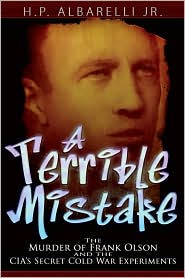
H.P. Albarelli Jr., is author of the book, A Terrible Mistake, The Murder of Frank Olson and the CIA's Secret Cold War Experiments. He describes what key people at the CIA have created. They were fervent anti communists, and had wealth and privilege, and saw themselves as modern day Knights Templar, above known laws. (See clip of film we used by that name here.)

On page 42 of 'A Terrible Mistake' H.P. Albarelli Jr., writes about the start up of a biological warfare project at then new Fort Detrick, (Detrick Field) in early 1942. The Roosevelt Administration ordered the DOD to 'take whatever measures were necessary to bring the United States up to speed with Axis and Allied powers'.

'In response, the War Department created the War Research Service (WRS), and installed George Wilhelm Merck as its director. Merck was a natural for the job, as he was already a high ranking consultant to the War Department on biological warfare. He was also head of Merck & Co., one of the oldest and largest pharmaceutical companies in the world. The firm had its beginnings in the late-1600's in Darmstadt, Germany as the E. Merck chemical factory. In 1891, George Merck, George Wilhalm's father, left Germany to establish Merck & Co., in New York City. His son, George Wilhelm Merck, born in West Orange, New Jersey and a Harvard graduate, had assumed control of the company in 1925. The younger Merck dynamically guided the company to become the largest full-line producer and distributor of pharmaceuticals in the world. Merck & Co. has since been responsible for countless innovations in the drug industry, including many in the controversial areas of enthnogenic products and shamanic inebriants'.

'In 1914, Merck's German operation was the first company worldwide to synthesize and patent methylene dioxymethamphetamine, or MDMA. As readers shall see, MDMA, a semi-synthetic psychoactive drug popularly known today as Ecstasy, was tested in the early-1950's under the codename EA-1475 at the Army's Edgewood Arsenal'.

TRT: 29:04
Produced by Dori Smith, Storrs, CT


Download at Pacifica's Audioport here or at Radio4all.net and Archive.org.


Part 1: H.P. Albarelli Jr. on his book, A Terrible Mistake, the Murder of Frank Olson and the CIA's Cold War Experiments

Previous portions of this interview are here part 2 and here part 3

… ‘So he seeks to stop us, to claim our treasure for himself. Pure madness. Let him try, every angel can fall…. Why do you not join us brother’. The Hollywood version of, The Knights Templar, a film – at that particular moment in the film, a Knight has been stabbed in the back. Frank Olson was likewise stabbed in the back, killed in fact, after being dosed with LSD without his knowledge. He was pushed out a window, according to this groundbreaking new book by H.P. Albarelli, Jr.

The creators of the CIA had a fascination with the crusades and other Knights Templar stories involving the Middle East, with stories of the Ark of the Covenant, Soloman’s Temple, and the visions of Ezekiel, important to Jewish mystics.
In Hank Albarelli’s book, A Terrible Mistake, we find that the men who created the CIA had a by any means necessary attitude about their version of national security, but they were also after corporate and political power. There was Allen Dulles, an oil industry executive, Dr. Sidney Gottleib, head of the TSS Technical Services Division that researched all means of controlling human beings, John Mulholland, an expert at sleight of hand and deception, and the former OSS officers, William Colby, Frank Wisner, and others, who saw themselves as modern day saints, saving Western civilization from the dark forces of communism.

Hank Albarelli is an investigative journalist who studied law, and worked in the Carter White House before turning to the study of financial institutions, unions, and biological and chemical warfare operations. His web site is www.albarelli.net

Rene Vargas, a law student on the negotiating committee at the University of Puerto Rico. He explained that they are worried about dramatic budget cuts and what would amount to an end to education for thousands of students.

More than 60% of the student body could lose the ability to attend college altogether. Rene Vargas is on the negotiating team, and he explained May 18, 2010) that initially, the school board refused their requests for meetings. Ultimately he was able to present the student's concerns and demands to administrators, but he said little came of it. And as the students learned more about what the school administrators planned to do, they became deeply concerned about the future of the 11 campuses at UPR. They sought further information on plans to sell or privatize portions of the school but were shut out of the process. They have accused the school board and government of a lack of transparency.

The widespread support for the students in Puerto Rico stems from the way they have been treated. First, the seriousness of their requests has been downplayed. and finally, the Governor delivered a state of the union address in which he chastised students, telling them their educations were inexpensive anyway.
The General Strike involved many different levels of students, and also some government workers. The Unions have negotiated a separate agreement with medical students as they work with patients.

www.talknationradio.org
write to us at talknationradio@gmail.com


News & Media Blog Directory